Omicron EVO-50 MBE System (EVO-0)

This is a three-chamber ultra-high vacuum (UHV) MBE system with a few customizations for the growth of oxide thin films purchased from Omicron, Germany. The features of each of the three chambers are below:
Chamber 1: Load Lock
- Pumped by a turbomolecular pump to < 10-8 Torr
- Houses a six-stage cassette holder for storing up to six two-inch diameter wafers or platens to adapt smaller substrates.
Chamber 2: Buffer chamber
- Pumped by an ion pump (Gamma Vacuum) to 10-10 – 10-9 Torr
- Heating stage for post-growth vacuum annealing up to 1300 °C
Chamber 3: Growth chamber
- A cryopump (Oxford Instruments), a magnetically levitated turbomolecular pump (Adixen) and a cryo shroud cooled with liquid nitrogen achieve pressures < 10-8 Torr
- An oxygen-compatible SiC heater stage (up to 1200 °C in POx = 1 × 10⁻⁵ Torr)
- Seven effusion cells for supplying metals and solid metal organic precursors
- Two vapor inlet systems built in-house for supplying liquid metal organic precursors
- An auto-tuned radio-frequency plasma source for oxygen (Seren Industrial Power Systems)
- In situ Reflection High Energy Electron Diffraction (RHEED, Staib Instruments) with a 15 kV electron gun for monitoring thin-film growth in real-time
- A residual gas analyzer (RGA) for compositional analysis of the chamber environment and leak testing
- A quartz crystal monitor (QCM) and beam flux monitor (BFM) for flux calibration
Omicron Dual MBE Systems (EVO-1 and EVO-2)
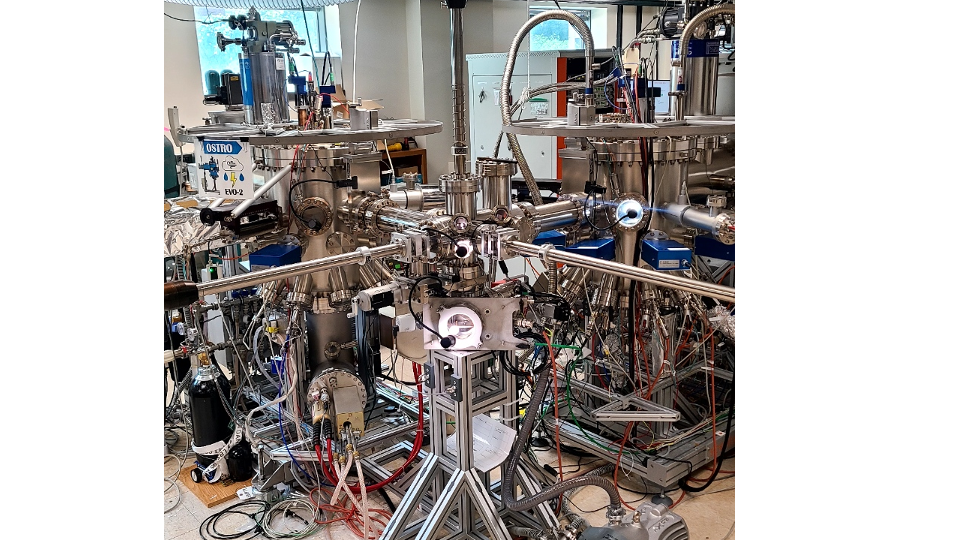
This system is equipped with two full-size Omicron EVO-50 MBE chambers (EVO-1 and EVO-2) connected through a buffer chamber and a load lock. The two MBE chambers enable the growth of oxide thin films and heterostructures of different classes of materials with two advantages - (1) pristine interfaces from in-situ growth and (2) lower risk of introducing unintentional dopants if the layers contain incompatible elements.
The features of the growth chambers are:
- A cryopump (Oxford Instruments), a magnetically levitated turbomolecular pump (Adixen) and a cryo shroud cooled with liquid nitrogen achieve pressures < 10-9 mBar
- An oxygen-compatible SiC heater stage (up to 1200 °C in POx = 1 × 10⁻⁵ mBar). EVO-2 has a rf/dc biasing option available on the substrate heater.
- Ten effusion cell ports for supplying elements in each chamber
- Three in-house built gas inlet systems for supplying liquid metal organics in EVO-1
- E-beam evaporator on EVO-2 for deposition of low vapor pressure metals
- An auto-tuned radio-frequency oxygen plasma source on EVO-1 and electron cyclotron resonance (ECR) oxygen plasma on EVO-2
- In situ Reflection High Energy Electron Diffraction (RHEED) set up with a 15 kV electron gun on EVO-1 and a 20 kV electron gun on EVO-2. Each system has a beam rocking capability and comes with a full-version of k-Space image acquisition and analysis software.
- A residual gas analyzer (RGA) for compositional analysis of the chamber environment and leak testing
- A quartz crystal monitor (QCM) and beam flux monitor (BFM) for flux calibration
Quantum Design DynaCool Physical Property Measurement System (PPMS)

The Quantum Design DynaCool is operated as a closed-loop system with heat exchange between liquid helium supplied with a compressor and ultra-pure helium gas. This instrument is set up as a shared facility through MRSEC.
Features:
- Operating temperature range of 1.8 K - 400 K
- 9 T superconducting magnet
- Resistivity Option for DC electrical transport
- Electronic Transport Option (ETO) for AC electrical transport
- Horizontal Rotator Probe for changing magnetic field direction with respect to the sample normal during DC electrical transport
- Thermal Transport Option (TTO) for Seebeck and thermal conductivity measurements
- Helium-3 refrigerator for DC and AC electrical transport down to 0.35 K
- Integration with external source measurement units (SMUs) for customized experiments such as electrostatic gating
- Impedance analyzer for temperature- and frequency-dependent dielectric measurements
Selenide MBE

This is a home-built UHV selenide MBE system and is currently being installed.
Features:
- Six effusion cells for supplying elements for the growth of selenides
- Pumped by a turbo pump which can achieve pressures below 10-9 Torr
Quantum Design FusionScope

The FusionScope (Quantum Design, USA) allows for correlated atomic force microscopy (AFM) and scanning electron microscopy (SEM) for studying functional materials. It has additional modules for room-temperature magnetic force microscopy (MFM) and piezoresponse force microscopy (PFM).
AFM Features:
- Self-sending piezoresistive cantilevers for scanning in the AC mode and contact mode
- Scan range is 22 μm (along X-axis), 22 μm (along Y-axis), and 11 μm (along Z-axis)
SEM Features:
- Thermal field emission electron source with an acceleration voltage range of 3.5 – 15 kV
- Imaging along different orientations of the sample with respect to the electron beam is enabled by tilting the trunnion in the -10° – 80°
- Magnification of 25X – 200,000X
Furnace

The furnace is used for annealing thin films under different environments after growth and device fabrication.
Features:
- Up to eight steps for ramping and holding temperature
- Controlled gas atmosphere of oxygen, nitrogen, or argon supplied through gas cylinders containing ultra-pure gasses
- Maximum annealing temperature of 1400 °C
Probe Station with Impedance Analyzer

Probe station with four probes, a two-channel source measure unit, an impedance analyzer, and a ferroelectric analyzer. It will be integrated with an existing Dynacool PPMS system and a custom-made heating stage. This setup allows us for very quick measurements of room-temperature resistivity, dielectric constant vs frequency, and P-E loops. These measurements provide critical feedback for the growth optimization of thin films.
Ferroelectric Testing and Energy Conversion

This is a custom-built setup equipped with a heater stage, probes, source meters, impedance analyzer, and ferroelectric tester (Radiant) for the energy conversion project. These sources are computer-controlled using lab-view software for easier and faster control and recording of data.
Glovebox

The four-arm glove box system is currently under installation and will be used for testing air-sensitive thin film samples and free-standing membranes.
Features:
- Argon environment with a fully functional regeneration system
- Oxygen concentration of < 20 ppm
- Water vapor concentration of < 100 ppm
Across International Vacuum Oven
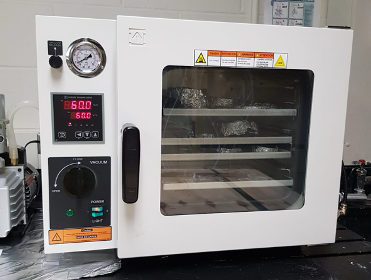
The vacuum oven is used for the preparation, storage, and drying of ionic gels for the electrostatic and electrochemical gating of thin film samples. It prolongs the ion gel’s shelf life.
Features:
- Oven temperature can be controlled from ambient temperature to 150˚C
- Ultimate vacuum level of 500 mTorr.
Instruments in Characterization Facility (CharFac)
Our lab extensively uses many instruments in the state-of-the-art Characterization Facility provided by the College of Science and Engineering at the University of Minnesota. A list of routinely used instruments is as follows:
- X-ray scattering: High-resolution X-ray diffractometer with a heating and cooling stage, X-ray diffractometer with a 2D detector and a heating stage
- Ion beam analysis: Rutherford backscattering spectrometry, particle induced X-ray emission
- Microscopy: atomic force microscope with piezoresponse force microscopy capability, scanning electron microscope
- Spectroscopy: spectroscopic ellipsometer, X-ray photoelectron spectrometer, confocal Raman microscope
Instruments in Minnesota Nano Center (MNC)
The Minnesota Nano Center at the University of Minnesota has two Class 100 cleanrooms capable of fabricating sub-10 nm features and a Nanomaterials lab. We rely heavily on these facilities for fabricating devices to study the optoelectronic properties of oxide thin films and membranes. We routinely use the following instrument capabilities:
- Deposition: electron beam evaporator, thermal evaporator, sputtering system, chemical vapor deposition system for graphene deposition
- Photolithography: spinners for photoresist spin-coating, contact aligners
- Etching: reactive ion etcher
- Annealing: rapid thermal annealer
- Spectroscopy: spectroscopic ellipsometer
- Material handling: controlled environment glovebox, exfoliation glovebox with a transfer arm
Other tools: dicing saw, gold wire bonder